How to use a pendulum for yes-no answers – a quick overview
Learning how to use a pendulum for yes-no questions is simpler than most people expect. You hold a weighted object on a string, establish your baseline swings for “yes” and “no,” then ask clear, single-answer questions and observe the movement. Most people find they get consistent responses within a few practice sessions.
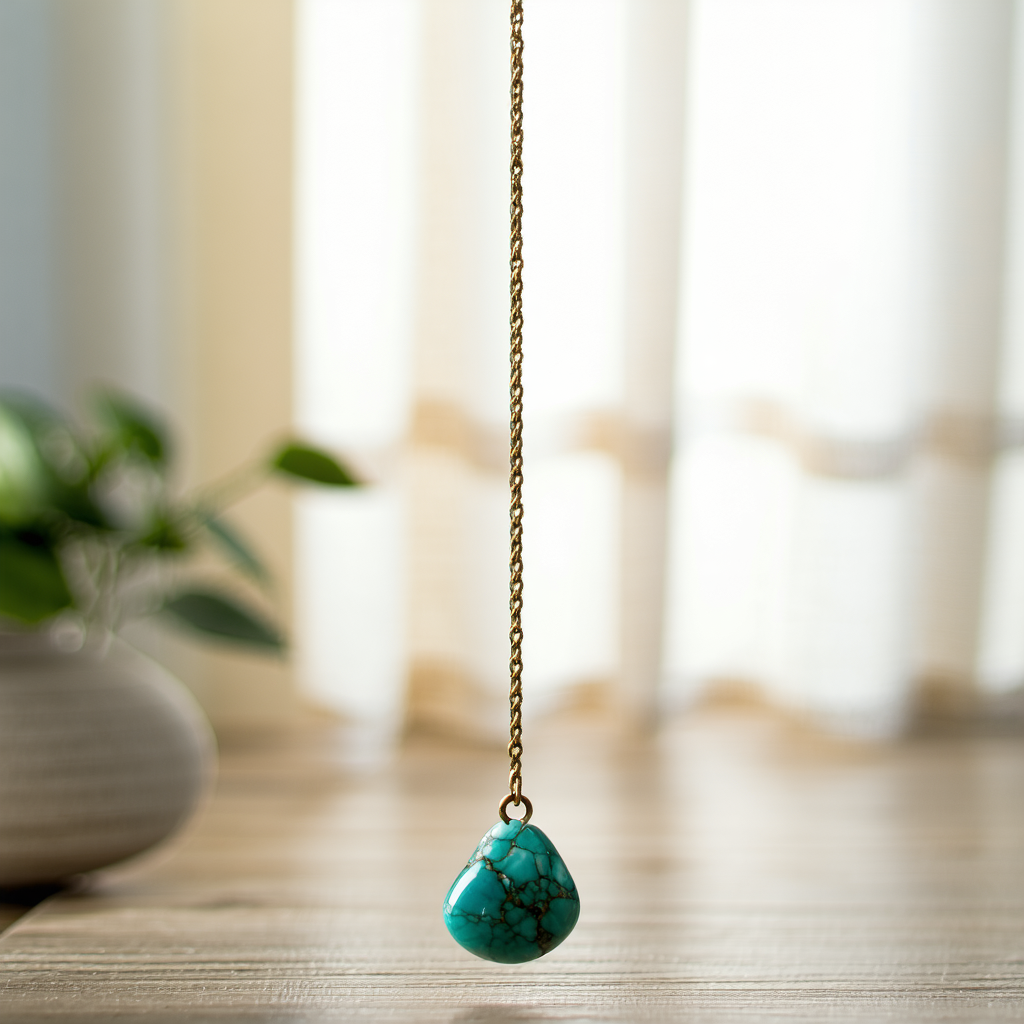
Table of contents
- What is a pendulum and how does it work
- Choosing the right pendulum for you
- Step 1 – Ground and centre yourself
- Step 2 – Establish your yes-no baseline
- Step 3 – Program your pendulum responses
- Step 4 – Ask clear, specific questions
- Step 5 – Read and interpret the swing
- Step 6 – Close the session properly
- Step 7 – Build a consistent practice
- Common mistakes to avoid
- Practical uses for pendulum work
- Frequently asked questions
What is a pendulum and how does it work
A pendulum is any weighted object – a crystal, a metal bob, even a ring on a thread – suspended so it can swing freely. When you hold it still and ask a question, tiny unconscious muscle movements in your hand, called the ideomotor effect, cause it to move in a particular direction.
The American Psychological Association describes ideomotor responses as small, involuntary movements that happen without conscious intention. This is the same mechanism behind a dowsing rod or a Ouija board planchette. Understanding this helps you approach pendulum work honestly – the answers come from within you, not from an external force.
That framing is actually empowering. When you learn how to use a pendulum for decision-making or self-reflection, you are essentially creating a feedback loop with your own intuition. Many people find that regular practice helps them tune into gut feelings they would otherwise ignore.
Choosing the right pendulum for you
You do not need an expensive crystal pendulum to get started. A simple metal washer on a piece of thread works perfectly well. That said, choosing something you feel drawn to can make the practice feel more intentional and enjoyable.
Key features to look for
- Weight – between 10 g and 30 g gives a responsive but stable swing
- Chain or string length – 6 to 12 inches is a comfortable working length for most people
- Balance – the weight should hang symmetrically so it does not drift on its own
- Material – metal, crystal, wood, and glass all work; choose what feels good in your hand
I started my own practice with a small amethyst pendulum I found at a local market. Honestly, the material made no measurable difference to accuracy – what mattered most was that holding it felt natural and kept me focused on the practice.
Step 1 – Ground and centre yourself
Before you explore how to use a pendulum for any question, you need a calm, focused state of mind. If you are anxious, rushed, or emotionally charged about the outcome, your ideomotor responses may reflect that agitation rather than a clear inner signal.
Spend two to five minutes in slow, diaphragmatic breathing before you begin. Breathe in for four counts, hold for two, and out for six. Some people find a short body-scan meditation or a brief walk outdoors helpful. The goal is to reduce mental noise, not to achieve any special spiritual state.
A simple grounding routine
- Sit comfortably with both feet flat on the floor
- Take five slow breaths, exhaling fully each time
- Set a clear intention – for example, “I am open to honest answers”
- Hold the pendulum loosely but steadily between your thumb and index finger
Grounding is the step most beginners skip, and it is the one that makes the biggest difference. When I rush into a session without settling first, the swing tends to be erratic and hard to read.
Step 2 – Establish your yes-no baseline
One of the most important parts of learning how to use a pendulum for yes-no questions is establishing your personal baseline – the specific movements that mean yes and no for you. These are not universal; they vary from person to person and even from session to session when you are new to the practice.
Hold the pendulum still and ask it to show you “yes.” Watch what happens. It might swing forward and back, side to side, or in a clockwise or counter-clockwise circle. Whatever it does consistently is your yes signal. Repeat the process for “no.”
Common yes-no movement patterns
- Forward and back swing – often indicates yes for right-handed holders
- Side to side swing – commonly indicates no
- Clockwise circle – yes for many practitioners
- Counter-clockwise circle – often no
- Diagonal swing – may indicate “unclear” or “ask differently”
- No movement – sometimes signals that the question cannot be answered as asked
There is no single correct answer here. What matters is that your baseline is consistent for you. Test it by asking a few questions you already know the answer to – your name, your age, your eye colour. If the pendulum confirms those accurately, your baseline is reliable.
Step 3 – Program your pendulum responses
Once you have observed your natural baseline, you can reinforce it. This is what practitioners call “programming” the pendulum, though a more grounded way to think about it is training your ideomotor response to be consistent.
Hold the pendulum and say aloud or silently: “When I ask a yes-no question and the answer is yes, please swing forward and back. When the answer is no, please swing side to side.” Then confirm by asking your known-answer test questions again.
Knowing how to use a pendulum for consistent results depends on repeating this programming step at the start of each session, especially when you are still building the habit. Over time, the responses tend to become automatic and you may only need a quick check-in rather than a full programming sequence.
Step 4 – Ask clear, specific questions
The quality of your questions determines the usefulness of your answers. This is where most beginners struggle. Vague, multi-part, or emotionally loaded questions produce confusing swings that are hard to interpret.
How to frame effective yes-no questions
A good pendulum question has one answer, is specific, and is phrased in the present or near-future tense. Here are some examples of weak versus strong questions:
- Weak: “Should I change my career or stay where I am?”
- Strong: “Is it in my best interest to apply for the marketing role at Company X this month?”
- Weak: “Will I be happy?”
- Strong: “Does taking a daily walk before work support my mood right now?”
- Weak: “Is my friend upset with me or just busy?”
- Strong: “Is reaching out to my friend today a good idea?”
I have found that writing questions down before a session helps enormously. When I improvise questions on the spot, I tend to phrase them poorly and then second-guess the answers. A short written list keeps the session focused and the results more trustworthy.
Also avoid questions about health diagnoses or financial predictions where the stakes are high and professional advice is the right tool. Pendulum work is well suited to personal reflection and low-stakes decisions – not to replacing a doctor or financial adviser.
Step 5 – Read and interpret the swing
Once you have asked your question, hold the pendulum steady, breathe normally, and wait. Try not to stare at it with intense focus – a soft gaze works better. The movement will usually begin within 10 to 30 seconds.
When you are learning how to use a pendulum for accurate readings, it helps to notice not just the direction but also the strength of the swing. A strong, decisive movement often feels different from a weak, hesitant one. Some people interpret a weak swing as a soft yes or no, while a vigorous swing feels like a clear confirmation.
Interpreting ambiguous responses
Sometimes the pendulum moves in a way that does not match your baseline clearly. Here is what those signals may suggest:
- Circular motion when you expected linear – the question may need rephrasing
- No movement at all – you may be too emotionally invested, or the question is not answerable as asked
- Alternating directions – conflicting inner signals; try grounding again before repeating
- Very slow, small movement – may indicate uncertainty rather than a clear yes or no
If you get an unclear answer, do not keep asking the same question hoping for a different result. Rephrase it, take a breath, and try once more. If it remains unclear, set it aside and return to it another day.
Step 6 – Close the session properly
Closing a pendulum session is a practical habit, not a mystical ritual. It simply means bringing your attention back to the present, noting your answers, and stopping before fatigue sets in.
Long sessions – more than 15 to 20 minutes – tend to produce less reliable results because mental fatigue affects ideomotor responses. Keep sessions short and purposeful. When you are done, hold the pendulum still with your other hand to stop the swing, take a few breaths, and set it down.
Keeping a simple journal of your questions and answers is one of the most useful habits you can build alongside learning how to use a pendulum for personal clarity. Over weeks and months, patterns emerge that show you where your intuition is strongest and where you may have blind spots.
What to record after each session
- The date and time
- Your emotional state before the session
- Each question asked and the response received
- Any follow-up actions you plan to take
- How the outcome played out (review weekly)
Step 7 – Build a consistent practice
Like any reflective practice – journaling, meditation, or breathwork – pendulum work improves with regularity. The more you practice, the more reliable your ideomotor responses become and the better you get at asking well-formed questions.
Start with two or three short sessions per week rather than daily long sessions. This keeps the practice fresh and prevents it from becoming a crutch for every small decision. The goal of learning how to use a pendulum for self-reflection is to strengthen your own decision-making confidence, not to outsource every choice.
Over time, many people find they use the pendulum less frequently because the practice has helped them trust their own intuition more directly. That is a healthy outcome – the tool has done its job.
Tips for building the habit
- Keep your pendulum in a visible place so it prompts regular use
- Pair sessions with an existing habit – morning tea, evening wind-down
- Review your journal monthly to track accuracy and patterns
- Take a week off occasionally to reset and avoid over-reliance
Common mistakes to avoid when using a pendulum
Even experienced practitioners make these errors. Being aware of them helps you get cleaner, more useful results from your sessions.
Asking leading questions
If you already strongly want a particular answer, your ideomotor response will often deliver it. This is not useful feedback – it is confirmation bias expressed through muscle movement. Try to notice when you have a strong preference and either set that question aside or ask it from a genuinely neutral state.
Moving the pendulum consciously
Some people, especially beginners, unconsciously nudge the pendulum in the direction they want. This is normal and does not mean you are “cheating” – it is simply the ideomotor effect being stronger than your neutral intention. Grounding well before each session reduces this significantly.
Asking the same question repeatedly
If you ask the same question five times hoping for a yes after getting four nos, you are not using how to use a pendulum for genuine insight – you are using it for reassurance. Trust the first clear answer you receive.
Using it for high-stakes decisions alone
Pendulum work is a reflective tool, not a replacement for professional advice, research, or rational analysis. Use it alongside other information-gathering, not instead of it.
Practical uses for pendulum work in everyday life
Once you understand how to use a pendulum for basic yes-no questions, the range of practical applications is wider than most people expect. Here are some areas where many people find pendulum reflection genuinely helpful.
Personal wellness and daily habits
Some people use pendulum questions to check in with their body’s signals – for example, asking whether a particular supplement, food choice, or sleep schedule feels right for them right now. This is not a diagnostic tool, but it can surface intuitive preferences that support healthier habits. Research on mind-body awareness, such as work referenced by the National Center for Complementary and Integrative Health, suggests that tuning into bodily signals may support overall wellbeing.
Decision-making and priorities
When you face a list of options and feel genuinely uncertain, working through them one by one with a pendulum can help you identify which options feel most aligned. This is particularly useful for lower-stakes choices – weekend plans, creative projects, minor scheduling decisions – where overthinking is the real obstacle.
Emotional clarity
Sometimes you feel a vague discomfort but cannot name it. Asking targeted yes-no questions – “Is this feeling related to work? To a relationship? To my own expectations?” – can help you narrow down the source and address it more directly.
Creative and intuitive exploration
Writers, artists, and other creative practitioners sometimes use pendulum work to break through indecision about a project direction. It functions as a structured way to access gut preference when the rational mind is going in circles.
Frequently asked questions
How long does it take to learn how to use a pendulum for yes-no questions?
Most people get consistent, readable responses within two to four sessions. The first session is usually about establishing your baseline and getting comfortable with the physical sensation of holding the pendulum. By the third or fourth session, the movements tend to become clearer and more reliable. Patience matters more than talent here.
Can anyone learn how to use a pendulum for self-reflection?
Yes. The ideomotor response is a normal physiological phenomenon that everyone experiences. You do not need any special ability, spiritual background, or prior experience. What helps most is a calm state of mind, clear questions, and a willingness to practice consistently over a few weeks.
What is the best pendulum for beginners?
A simple metal bob on a 6-to-8-inch chain is an excellent starting point. It is inexpensive, well-balanced, and responsive. Many beginners also use a ring on a thread or a small crystal pendant they already own. The material matters far less than the balance and weight of the object.
Why does my pendulum not move?
The most common reasons are tension in your hand or wrist, a rushed or anxious mental state, or a question that is too emotionally loaded. Try grounding for a few extra minutes, loosen your grip slightly, and rephrase your question more neutrally. If it still does not move, rest for a day and try again – fatigue and stress both suppress ideomotor responses.
Is pendulum work the same as dowsing?
They share the same underlying mechanism – the ideomotor effect – but are applied differently. Dowsing traditionally involves searching for water or minerals by walking with a rod or pendulum over an area. Pendulum work for yes-no questions is a stationary, introspective practice focused on personal decision-making and self-reflection rather than locating physical objects.
How do I know if my pendulum answers are accurate?
The most reliable way to test accuracy is to ask questions you already know the answer to and see whether the pendulum confirms them consistently. Over time, keeping a journal and reviewing outcomes helps you identify how accurate your sessions tend to be. Most people find accuracy improves with practice and with better question framing.
Can I use any object as a pendulum?
Yes. A button on a thread, a small key on a string, or even a paperclip on dental floss can work as a functional pendulum. The key requirements are that the object hangs symmetrically, has enough weight to swing visibly, and is attached to something flexible enough to move freely. Dedicated pendulums are convenient but not necessary, especially when you are just starting out.
How often should I use a pendulum?
Two to three times per week is a good rhythm for beginners. Daily use is fine once you are comfortable with the practice, but it is worth taking occasional breaks to avoid over-reliance. The aim of learning how to use a pendulum for personal clarity is to build trust in your own intuition – not to create a dependency on the tool for every decision you face.
For more practical wellness ideas, browse the Health Living Today guide library.