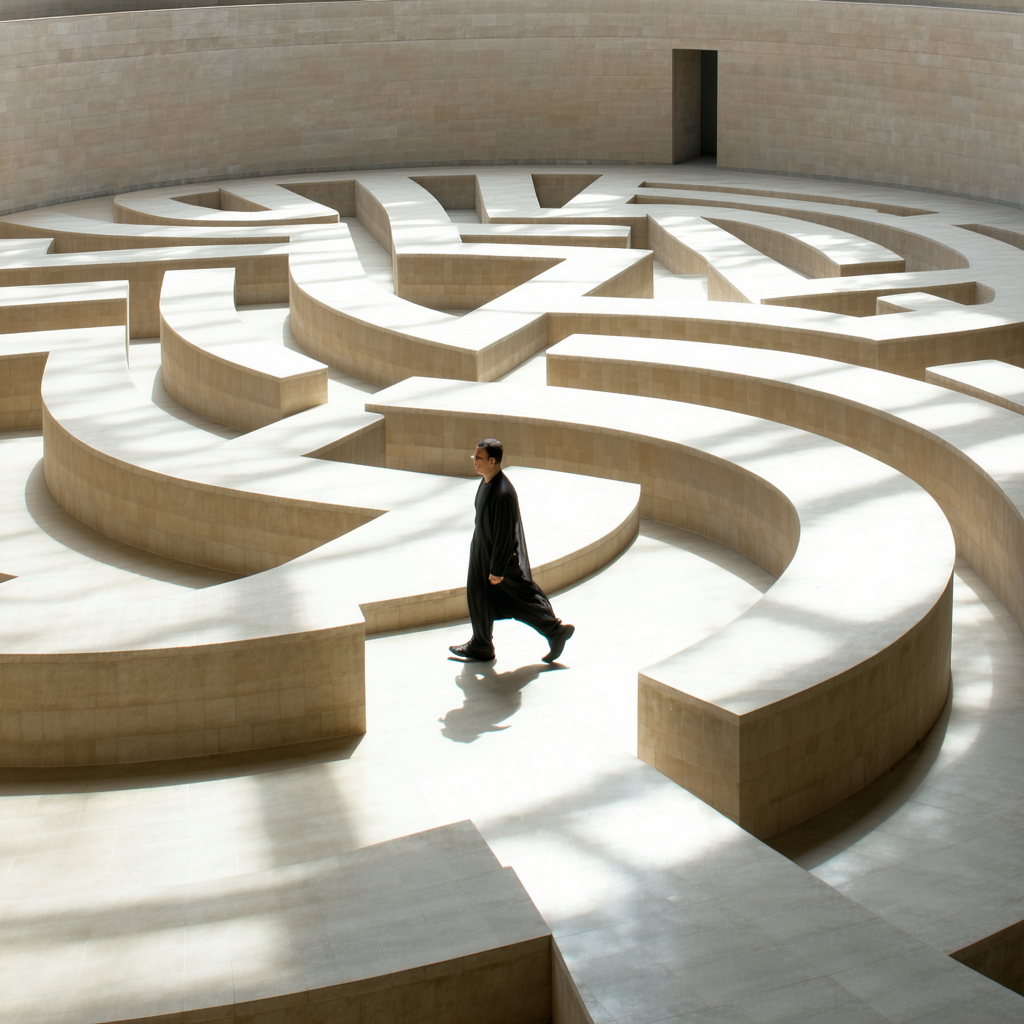
What is labyrinth walking meditation and does it actually work?
Labyrinth walking meditation is a mindfulness practice in which you follow a single winding path to a center point and back out again, using the walk itself as a moving form of meditation. Research and centuries of tradition suggest it may support stress reduction, mental clarity, and a sense of calm – without requiring any prior meditation experience. I have found it to be one of the most accessible contemplative practices available, because the path itself does the navigating for you.
Table of contents
- What is a labyrinth – and how is it different from a maze?
- A brief history of labyrinth walking as a meditative practice
- What the evidence says about labyrinth walking meditation benefits
- How to do labyrinth walking meditation – a step-by-step guide
- How to find a labyrinth near you
- Using a finger labyrinth when you cannot walk one
- Practical tips for building a regular labyrinth walking meditation practice
- Common mistakes and how to avoid them
- Frequently asked questions
What is a labyrinth – and how is it different from a maze?
One path, one destination
A labyrinth has a single, non-branching path that leads you to the center and back out the same way. There are no dead ends, no wrong turns, and no choices to make along the route. That is the key distinction from a maze, which is deliberately designed to confuse you with multiple routes, dead ends, and decision points.
Because a labyrinth removes the problem-solving element entirely, your thinking mind gets to quiet down. You do not need to figure out where to go next. The path is already there – your only job is to walk it.
The classical seven-circuit design
The most common design you will encounter is the classical seven-circuit labyrinth, sometimes called the Cretan labyrinth. It features seven concentric rings connected by a single continuous path. You will also see eleven-circuit and twelve-circuit versions, most famously the medieval design laid into the floor of Chartres Cathedral in France around 1201 CE.
Both designs work equally well for labyrinth walking meditation. The number of circuits changes the duration of the walk, not the fundamental quality of the experience.
A brief history of labyrinth walking as a meditative practice
Ancient roots across many cultures
Labyrinth patterns appear in rock carvings, pottery, and architecture across at least four thousand years of human history – in Crete, India, Scandinavia, and among Indigenous peoples of the American Southwest. They were not always used for meditation in the modern sense, but they consistently held ritual and spiritual significance.
In medieval Christian Europe, walking the labyrinth at Chartres was sometimes used as a substitute pilgrimage for those who could not travel to Jerusalem. The physical act of walking a winding path toward a center became a metaphor for the spiritual journey inward.
The modern revival
The contemporary labyrinth walking meditation movement gained significant momentum in the 1990s, largely through the work of the Reverend Dr. Lauren Artress at Grace Cathedral in San Francisco. She introduced a full-scale replica of the Chartres labyrinth and made it available to the public as a contemplative tool. That work helped shift labyrinth walking from a niche religious practice into a broadly accessible wellness activity.
Today, labyrinths can be found in hospitals, hospice centers, parks, schools, and retreat centers worldwide. The Labyrinth Society maintains a global locator with thousands of registered sites.
What the evidence says about labyrinth walking meditation benefits
Stress and anxiety
Labyrinth walking meditation may support a reduction in perceived stress and anxiety. A 2017 pilot study published in the Journal of Holistic Nursing found that a single session of labyrinth walking produced statistically significant reductions in anxiety scores among participants. The researchers noted that the combination of rhythmic walking and focused attention appeared to activate the parasympathetic nervous system – the body’s rest-and-digest mode.
This aligns with what we know about walking in general. Moderate-paced walking is associated with lower cortisol levels and improved mood. Adding a meditative intention to that walk appears to amplify those effects for many people.
Mental clarity and creative thinking
Some people find that labyrinth walking meditation helps them arrive at new perspectives on problems they have been carrying. The repetitive, low-demand nature of following a known path may free up cognitive resources that were previously occupied by planning and decision-making.
I have noticed this myself – I once walked a hospital labyrinth while trying to work through a difficult professional decision, and by the time I reached the center, the answer felt obvious in a way it had not before the walk. I am not claiming the labyrinth gave me the answer; I think it simply gave my mind the space to find it.
Emotional processing and grief support
Labyrinth walking is increasingly used in palliative care and grief support settings. The structure of the walk – moving inward, pausing at center, then returning outward – maps naturally onto the human experience of entering difficulty, sitting with it, and emerging changed. Some people find this structure emotionally meaningful in a way that seated meditation does not offer.
The National Institutes of Health’s National Library of Medicine has indexed multiple studies examining labyrinth walking in clinical and wellness contexts, reflecting growing academic interest in this practice.
Physical movement benefits
Labyrinth walking meditation is also simply walking – and walking carries its own well-documented benefits for cardiovascular health, blood sugar regulation, and joint mobility. For people who find seated meditation physically uncomfortable, the walking format may be a more sustainable entry point into a regular practice.
How to do labyrinth walking meditation – a step-by-step guide
Before you begin
Choose a pace that feels natural and unhurried. You do not need to walk slowly in an exaggerated way – just slower than your usual purposeful stride. Wear comfortable shoes, or walk barefoot if the surface allows and you feel comfortable doing so.
Set a loose intention before you enter the path. This does not need to be elaborate. It might be as simple as “I am here to be present” or a specific question you are carrying. Some people prefer to enter with no agenda at all, simply open to whatever arises.
The three phases of labyrinth walking meditation
Most labyrinth walking traditions describe three natural phases to the walk. Understanding these can help you work with the experience more consciously.
- Releasing (the inward walk): As you walk toward the center, allow your thoughts to settle. Some practitioners use this phase to consciously let go of mental clutter – worries, to-do lists, background noise. You do not need to force this. Simply notice what arises and return your attention to your feet, your breath, or the path ahead.
- Receiving (the center): When you arrive at the center, pause. Stay as long as feels right – this might be thirty seconds or ten minutes. Some people sit, some stand, some simply breathe. This is the still point of the practice, a moment of open receptivity.
- Returning (the outward walk): The walk back out is not a retreat – it is often described as a return to the world with whatever you gathered at the center. Some people find this phase energizing. Others use it to consolidate or integrate what they noticed on the way in.
Where to place your attention
During labyrinth walking meditation, you have several options for your attentional anchor. None is more correct than another – experiment to find what works for you.
- Breath awareness: Follow the natural rhythm of your breathing as you walk. Let each step coordinate loosely with an inhale or exhale.
- Foot sensation: Notice the feeling of each foot making contact with the ground. This is a grounding practice that keeps attention in the body.
- Mantra or phrase: Silently repeat a word or short phrase that holds meaning for you. This is especially useful if your mind is very active.
- Open awareness: Simply notice what is present – sounds, light, temperature, the curves of the path – without latching onto any one thing.
What to do when your mind wanders
Your mind will wander. That is not a problem – it is the practice. Each time you notice that you have drifted into planning, worrying, or daydreaming, gently return your attention to the path and your chosen anchor. The labyrinth path itself helps here: if you find yourself lost in thought, the physical act of following the curves tends to pull attention back to the body.
After the walk
Take a few minutes after completing the walk before returning to your regular activities. Sit quietly, write in a journal, or simply stand at the entrance and breathe. This transition time helps you carry the quality of the practice into the rest of your day rather than immediately losing it in the next task.
How to find a labyrinth near you
The World-Wide Labyrinth Locator
The most comprehensive resource for finding a walkable labyrinth is the World-Wide Labyrinth Locator, a database maintained jointly by the Labyrinth Society and Veriditas. You can search by location, labyrinth type, and whether the site is publicly accessible. At the time of writing, the database lists over six thousand labyrinths across more than eighty countries.
Many labyrinths are on hospital grounds, in public parks, at churches and retreat centers, or on university campuses. Access is often free and unrestricted, though some sites request a donation or ask you to schedule a visit in advance.
What if there is no labyrinth near you?
If you cannot easily access a physical labyrinth, you have several practical alternatives. Portable canvas labyrinths can be rented or purchased and unrolled in a gym, community center, or large outdoor space. Some practitioners create temporary labyrinths outdoors using rope, stones, or chalk on pavement.
You can also use a printed or digital labyrinth image as a finger labyrinth – more on that in the next section.
Using a finger labyrinth when you cannot walk one
What is a finger labyrinth?
A finger labyrinth is a scaled-down version of the labyrinth pattern that you trace with your fingertip rather than walk with your feet. It can be printed on paper, carved into wood, or molded into ceramic. The meditative principle is identical to walking: you follow the single path inward to the center, pause, and trace back out.
Research suggests that finger labyrinths may produce some of the same calming effects as walking ones. A study cited in integrative health literature found that tracing a finger labyrinth reduced heart rate and self-reported anxiety in a clinical waiting room setting. The tactile engagement appears to anchor attention in a way similar to the physical walk.
How to use a finger labyrinth effectively
Place the labyrinth on a flat surface or hold it in your non-dominant hand. Use the index finger of your dominant hand to trace the path slowly. Breathe naturally. If your mind wanders, the physical sensation of the path edge under your fingertip serves as a ready anchor to return to.
Finger labyrinths are particularly useful in settings where walking is not possible – during a stressful workday, in a waiting room, or late at night when you want to wind down without leaving your home.
Practical tips for building a regular labyrinth walking meditation practice
Start with what you have
You do not need a perfect outdoor stone labyrinth to begin. A finger labyrinth printed from a free online template works fine. A canvas labyrinth at a local retreat center works fine. Starting imperfectly is far more useful than waiting for ideal conditions.
In my own routine, I began with a printed paper finger labyrinth on my desk before I ever walked a full-size one. That small, low-commitment starting point made it easy to build the habit before investing more time and travel.
Frequency and duration
Even a single labyrinth walk per week can produce noticeable shifts in stress levels and mental clarity for many people. If you have access to a nearby labyrinth, aim for once or twice a week as a starting point. A single walk on a seven-circuit labyrinth typically takes between ten and twenty minutes at a comfortable pace.
If you are using a finger labyrinth daily, five to ten minutes is sufficient to experience the settling effect. Consistency matters more than duration – a short daily practice tends to be more effective than occasional longer sessions.
Pair it with an existing habit
One of the most reliable ways to maintain any new practice is to attach it to something you already do. You might walk the labyrinth on the same morning you visit a particular park, or use a finger labyrinth every time you sit down for your morning coffee. The pairing reduces the friction of remembering and deciding.
Keep a simple journal
After each labyrinth walking meditation session, write two or three sentences about what you noticed. You do not need to produce polished reflections – just a quick note about your mood before, any images or thoughts that arose, and how you felt after. Over time, this record becomes a useful map of your own patterns and progress.
Walk with others occasionally
Labyrinth walking can be a solitary practice or a shared one. Walking with a small group – even silently – can deepen the experience. Many retreat centers and hospitals offer facilitated labyrinth walks, and the Labyrinth Society hosts an annual worldwide labyrinth day each May that includes public events in many cities.
Common mistakes and how to avoid them
Treating it like exercise
Labyrinth walking meditation is not a workout. If you walk at your usual purposeful pace, you will likely finish before your mind has had a chance to settle. Slow down deliberately at the entrance and allow the pace to communicate to your nervous system that this time is different from ordinary walking.
Expecting a specific experience
Some walks feel profound. Others feel ordinary, even boring. Both are valid. The mistake is arriving with a fixed expectation of what should happen – a revelation, a feeling of peace, a solved problem. Some people find labyrinth walking meditation deeply moving on their first try; others need several sessions before it clicks. Approaching each walk with open curiosity is more useful than arriving with a performance standard.
Skipping the pause at center
Many beginners walk straight through the center without pausing, treating it like a turnaround point. The center is actually the heart of the practice. Even a brief, deliberate pause – just a few breaths – changes the quality of the experience significantly. Do not skip it.
Worrying about other walkers
If you share a labyrinth with other people, you may find yourself walking at different speeds and occasionally needing to step aside to let someone pass. This is normal and expected. There is no formal right-of-way rule – simply be courteous and flexible. Most labyrinth walkers are absorbed in their own experience and will not be disturbed by gentle, mindful adjustments.
Giving up after one session
Labyrinth walking meditation, like any contemplative practice, tends to deepen with repetition. The first session introduces you to the form; subsequent sessions build familiarity and allow subtler layers of the experience to emerge. Give it at least four to six sessions before deciding whether it is a good fit for you.
Frequently asked questions
Is labyrinth walking meditation religious?
Labyrinth walking has roots in multiple religious traditions, including Christianity, but the practice itself is not inherently religious. Many people use it as a secular mindfulness or stress-reduction practice with no spiritual framing at all. You can approach it in whatever way is meaningful and comfortable for you.
How is labyrinth walking meditation different from regular walking meditation?
Regular walking meditation, as taught in Buddhist traditions, typically involves walking in a straight line or a simple oval, with close attention to each step. Labyrinth walking meditation adds the structure of a specific path with a defined center, which many people find easier to work with because the winding route naturally slows the pace and holds attention. The three-phase structure – inward, center, outward – also gives the practice a narrative arc that some find more engaging than an open-ended walk.
Can children do labyrinth walking meditation?
Yes. Children often take to labyrinth walking naturally, particularly when it is framed as an adventure or a quiet game rather than a formal meditation. Some schools have installed labyrinths as tools for focus and emotional regulation. Younger children may walk quickly and treat the center as a play space – that is fine. The benefits of focused movement and the experience of a defined, navigable path are still present.
Do I need to be physically fit to walk a labyrinth?
Labyrinth walking is low-impact and accessible to most fitness levels. People with mobility aids, including walkers and wheelchairs, can navigate many labyrinth designs, particularly those with wider paths. If walking is not possible, finger labyrinths offer the same meditative structure without any physical demands on the body.
How long does a labyrinth walk take?
This depends on the size of the labyrinth and your pace. A seven-circuit labyrinth walked at a slow, meditative pace typically takes between ten and twenty minutes for a complete inward-and-outward journey. A twelve-circuit Chartres-style labyrinth may take twenty to forty minutes at the same pace. You can also walk more quickly and still benefit – the practice adapts to the time you have available.
What should I think about during a labyrinth walking meditation?
There is no required content for your thoughts. Some people enter with a specific question or intention and allow their mind to work with it naturally. Others use a breath or mantra anchor and let thoughts arise and pass without engaging them. Still others simply pay attention to sensation and movement. All of these approaches are valid. The path takes care of the navigation – your only task is to show up and remain present as best you can.
Can labyrinth walking meditation replace other forms of therapy or treatment?
Labyrinth walking meditation is a wellness practice, not a medical treatment. It may support mental and emotional wellbeing as part of a broader self-care routine, but it is not a substitute for professional mental health care, medical treatment, or therapy. If you are dealing with a significant mental health concern, please work with a qualified healthcare provider.
For more practical wellness ideas, browse the Health Living Today guide library.