Sri yantra explained: what it is and why it matters
The sri yantra is a sacred geometric diagram used in Hindu and Tantric traditions for meditation, ritual, and the contemplation of cosmic principles – and once you understand its structure, its purpose becomes surprisingly clear. Sri yantra explained in the simplest terms: it is a visual map of consciousness, built from interlocking triangles that represent the union of masculine and feminine energy. In this article I walk through every layer of that map so you can engage with it practically, not just theoretically.
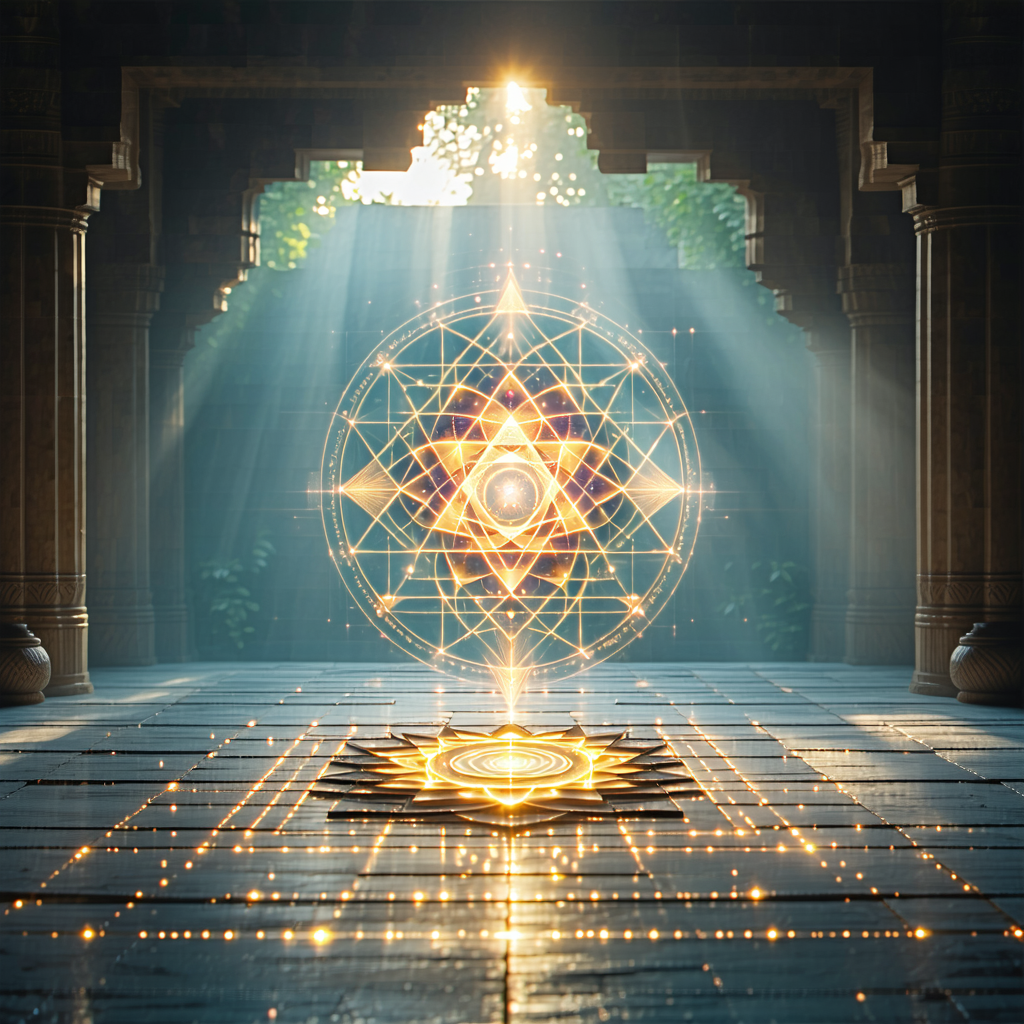
Table of contents
- What is the sri yantra
- Geometry and structure
- Meaning of each layer
- Sri yantra in practice – meditation and daily use
- History and tradition
- The science and wellness angle
- Choosing a sri yantra for your space
- Common mistakes beginners make
- Frequently asked questions
What is the sri yantra
The sri yantra – sometimes called the Sri Chakra – is considered the most revered of all yantras in the Shakta tradition of Hinduism. The word yantra comes from the Sanskrit root meaning “instrument” or “device,” and the prefix sri denotes auspiciousness and abundance. Together they describe a tool designed to focus the mind toward a specific quality of awareness.
I have found that people often confuse yantras with mandalas. While both are geometric and used in contemplative practice, a yantra is more precisely defined – its proportions are fixed by classical texts and carry specific symbolic meaning at every level. A mandala is a broader category that includes many types of sacred circle diagrams.
The sri yantra is associated primarily with the goddess Lalita Tripura Sundari, the embodiment of beauty, bliss, and the totality of existence. Meditating on the sri yantra is, in traditional terms, meditating on the nature of that goddess – and by extension, on the nature of reality itself.
Geometry and structure
The nine interlocking triangles
At the heart of the sri yantra explained properly is its triangular core. Nine triangles overlap in a precise configuration – four pointing upward and five pointing downward. The upward-pointing triangles represent Shiva, the masculine principle of pure consciousness. The downward-pointing triangles represent Shakti, the feminine principle of dynamic energy and matter.
These nine triangles create 43 smaller triangles in their intersections. The geometry is famously difficult to construct accurately by hand because all the intersection points must meet at exact locations – there is no room for approximation. Some scholars of sacred geometry consider the sri yantra one of the most mathematically demanding diagrams in any contemplative tradition.
The bindu – the central point
At the absolute center of the sri yantra sits the bindu, a single dot. This point represents the origin of all creation – the moment before differentiation, where consciousness and energy are undivided. In meditation practice, the bindu is the final destination of inward focus. You begin at the outer edge of the diagram and move your attention progressively inward until it rests at that single point.
Surrounding rings and lotus petals
Surrounding the nine triangles are two rings of lotus petals – an inner ring of eight petals and an outer ring of sixteen petals. Lotus imagery in Indian iconography consistently represents purity and the unfolding of potential. The eight inner petals correspond to eight aspects of mental activity, while the sixteen outer petals are associated with the sixteen vowels of the Sanskrit alphabet and with fullness of expression.
Beyond the lotus rings sit three concentric circles, and the entire design is enclosed within a square frame called the bhupura or earth-city. The bhupura has four T-shaped gates facing the cardinal directions, representing the threshold between ordinary awareness and the sacred space within.
Meaning of each layer
Understanding the sri yantra explained layer by layer helps you move through it intentionally during practice rather than just staring at the whole image at once.
Layer by layer breakdown
- Bhupura (outer square): Earth, the physical world, the starting point of practice.
- Three circles: The three qualities of nature – tamas (inertia), rajas (activity), and sattva (clarity).
- Sixteen-petal lotus: Fullness, the sixteen aspects of desire and fulfillment.
- Eight-petal lotus: The eight directions of space, the eight aspects of the mind in action.
- Fourteen-triangle complex (first outer ring): The fourteen powers of the world.
- Ten-triangle complex (outer): Ten aspects of the vital life force.
- Ten-triangle complex (inner): Ten aspects of the subtle body and protection.
- Eight-triangle complex: Eight aspects of speech and the eight mother goddesses.
- Central triangle: The three fundamental energies – will, knowledge, and action.
- Bindu: Pure undivided awareness, the source and goal.
This layered structure means the sri yantra is simultaneously a cosmological diagram, a map of the human psyche, and a guide for meditation. Each layer has a corresponding set of mantras, deities, and psychological qualities described in texts such as the Saundarya Lahari attributed to Adi Shankaracharya.
Sri yantra in practice – meditation and daily use
How to begin a sri yantra meditation
Sri yantra explained in a practical context starts with how you actually sit with it. I began my own practice by placing a printed sri yantra at eye level, about two feet in front of me, in a quiet corner of my home. The first few sessions felt more like visual puzzles than meditation – I kept getting lost in the triangles. Over time, though, the eye naturally learns to rest at the center.
A basic approach that many practitioners use involves these steps:
- Sit comfortably with a straight spine and close your eyes for two to three minutes to settle the nervous system.
- Open your eyes and let your gaze land softly on the outer boundary of the yantra without straining.
- Slowly allow your attention to move inward, passing through each ring and layer in sequence.
- Rest your gaze at the bindu for as long as feels natural – even thirty seconds is meaningful at first.
- Reverse the journey outward before closing your eyes again to finish.
This inward-then-outward movement is sometimes described as the path of involution and evolution – going back to source, then returning to the world refreshed.
Pairing the yantra with mantra
Many traditions pair the sri yantra with the Panchadashi or Shodashi mantra, both of which are initiatory and traditionally transmitted by a teacher. If you do not have access to a teacher, the simple mantra Om Sri Matre Namaha – a salutation to the auspicious mother – is widely used and considered appropriate for independent practice.
Chanting or silently repeating a mantra while holding the sri yantra in your visual field creates what practitioners describe as a dual anchor – sound and image reinforcing each other. Some people find this easier to sustain than silent gazing alone.
Using the sri yantra as a daily visual anchor
You do not need a formal meditation session to benefit from the sri yantra. Many people place it on a desk, a kitchen altar, or a bedside table as a visual reminder to return to a centered state. I have a small copper sri yantra on my desk, and even a glance at it during a stressful work call seems to interrupt the stress loop briefly. Whether this is symbolic, psychological, or something else entirely, the effect is real enough to be worth trying.
History and tradition
Origins in Tantric texts
The sri yantra appears in Tantric literature dating back at least to the early centuries of the Common Era, though its roots likely extend further. It is central to the Shri Vidya tradition, a sophisticated school of Tantric Shaivism and Shaktism that treats the universe as the self-expression of the goddess Lalita. The Lalita Sahasranama, a text listing one thousand names of the goddess, describes her as identical with the sri yantra itself.
The Saundarya Lahari – “Wave of Beauty” – is one of the most important texts for understanding the sri yantra explained in its full devotional context. Its opening verse describes the goddess as the source from which Shiva himself draws the power to act. The sri yantra is the geometric encoding of that relationship.
Geographic spread and variations
The sri yantra is found across South Asia and Southeast Asia in temple architecture, manuscript illumination, and ritual objects. In South Indian temples it is often engraved on the floor of the inner sanctum or on the meru – a three-dimensional pyramidal version of the diagram. The meru form of the sri yantra is considered particularly powerful in traditional practice because it adds the dimension of height, representing the ascent of consciousness.
Regional variations exist in the exact proportions used, and different lineages have their own methods of constructing and consecrating the yantra. The core structure – nine interlocking triangles, two lotus rings, three circles, square frame – remains consistent across all versions.
The science and wellness angle
What research suggests about geometric meditation
Sri yantra explained from a modern wellness perspective draws on research into focused attention meditation and the effects of visual complexity on the brain. While there is no large body of clinical research specifically on sri yantra practice, the broader category of focused visual meditation has been studied with encouraging results.
A review published by the National Institutes of Health on meditation and the brain found that focused attention practices – which include visual object meditation – may support improvements in sustained attention, emotional regulation, and stress response over time. The sri yantra, as a highly structured visual object, may serve as an effective anchor for this type of practice.
It is worth being clear: no one can claim the sri yantra treats or cures any condition. What some people find, and what the evidence for focused attention meditation more broadly suggests, is that a consistent practice of this kind may support a calmer baseline state and improved concentration.
The role of symmetry in perception
The human visual system has a strong innate response to symmetry. The sri yantra is radially symmetrical – it looks the same from any angle of rotation – and this property may be part of why many practitioners report a settling effect when gazing at it. Research in perceptual psychology has found that symmetrical patterns are processed more fluently by the brain and tend to produce lower arousal states compared to asymmetrical ones.
This is not mysticism – it is basic visual neuroscience. The sri yantra happens to combine extreme geometric complexity with perfect symmetry, which may create a unique cognitive state: engaged but not agitated, focused but not strained.
Stress, focus, and the value of ritual objects
Anthropologists and psychologists have noted that ritual objects – physical items associated with a consistent practice – can act as conditioned anchors for particular mental states. Over time, simply seeing the object begins to cue the state associated with it. If you meditate with your sri yantra every morning, the yantra itself may eventually prompt a degree of calm even when you are not formally meditating. This is a well-understood principle of associative learning, and it is one reason why having a physical sri yantra rather than just a digital image may be worth considering.
Choosing a sri yantra for your space
Material options
Sri yantras are available in a wide range of materials. Here is a quick comparison to help you decide:
- Paper or card print: Lowest cost, easy to find, good for beginners testing the practice. Less durable.
- Copper: Traditional material, considered energetically appropriate in Tantric texts. Affordable and long-lasting.
- Brass: Similar to copper, slightly more ornate in appearance, widely available.
- Silver or gold: Used in more formal devotional contexts. Significant cost, but considered ideal in classical practice.
- Crystal or gemstone: Popular in contemporary wellness contexts. No traditional basis for specific stones, but some people find the tactile quality of crystal meaningful.
- Meru (3D pyramid form): Traditional for home altars in the Shri Vidya lineage. More expensive and requires a stable flat surface.
Flat versus meru form
The flat two-dimensional sri yantra is the most common form and is entirely appropriate for meditation and home use. The meru form – a three-dimensional version where each layer of the yantra rises as a stepped pyramid – is considered the more complete representation in classical texts, because it adds vertical dimension to the horizontal map of consciousness.
For most people starting out, a flat copper or brass sri yantra is practical and sufficient. The meru form is worth exploring once you have established a consistent practice and want to deepen your engagement with the tradition.
Size and placement
For meditation use, a diameter of four to eight inches works well at a distance of one to three feet. For a wall piece or altar object, larger sizes up to twelve inches are common. Placement at eye level when seated is traditional – the idea being that you should not need to strain your neck up or down to hold the bindu in your line of sight.
Common mistakes beginners make
Treating it as purely decorative
The sri yantra has become a popular design element in jewelry, clothing, and home decor. There is nothing wrong with appreciating its beauty, but if your intention is to use it as a contemplative tool, treating it as wallpaper will not get you very far. Even five minutes of intentional practice with the sri yantra – sitting quietly, moving your attention through its layers – is more valuable than having it on a t-shirt you never think about.
Expecting immediate results
Sri yantra explained honestly includes this: the practice takes time to settle into. In my own experience, the first two weeks felt neutral at best. The shift came gradually, and I only noticed it in retrospect – a slightly easier time returning to calm after stress, a small increase in my ability to sit still. Do not judge the practice by the first session.
Getting lost in the geometry
The triangles are visually captivating, and it is easy to spend a session mentally tracing lines and counting intersections. This is interesting but it is not the same as meditation. The goal is to move attention inward toward the bindu and rest there – not to analyze the diagram intellectually. Save the analysis for reading and study; during practice, let the image be a gateway rather than a puzzle.
Skipping the grounding steps
Jumping straight into gazing at the sri yantra without any settling period tends to produce a restless session. Two to three minutes of slow breathing before you open your eyes makes a significant difference in how quickly the mind quiets. This is not specific to sri yantra practice – it applies to any focused attention meditation – but beginners often skip it and then conclude the practice does not work.
Frequently asked questions
What does sri yantra explained mean for someone with no background in Hinduism?
You do not need a Hindu background to work with the sri yantra. At its most accessible level, it is a structured visual object that supports focused attention meditation. Many people use it as a secular contemplative tool, appreciating the geometry and using it as a concentration anchor without adopting any theological framework. The depth of traditional meaning is there if you want to explore it, but it is not a prerequisite for finding the practice useful.
Is the sri yantra the same as a mandala?
Not exactly. A mandala is a broad category of sacred circle diagram used across many traditions including Buddhist, Hindu, and Jain practice. The sri yantra is a specific yantra – a precisely defined geometric instrument – that belongs within the Hindu Tantric tradition. All sri yantras have a circular quality, but not all mandalas are sri yantras. The key difference is the fixed, mathematically precise structure of the sri yantra versus the more varied forms a mandala can take.
How long should I meditate on the sri yantra each day?
Even ten to fifteen minutes daily is enough to build a meaningful practice over time. Some practitioners in classical traditions sit for up to an hour, but there is no evidence that longer sessions are necessary for most people’s purposes. Consistency matters more than duration – a ten-minute daily practice will likely serve you better than an occasional hour-long session.
Can I place the sri yantra anywhere in my home?
Traditional guidance suggests placing it in a clean, dedicated space – an altar corner, a meditation room, or a quiet desk area. Placing it in a bathroom or on the floor is generally considered disrespectful to the tradition. If you are using it purely as a decorative item with no contemplative intention, placement is less significant. If you want to use it as a practice tool, treating the space around it with some care seems to support the associative anchoring effect described earlier.
What is the difference between a sri yantra and a sri chakra?
The terms are used interchangeably in most contexts. Technically, yantra emphasizes the geometric instrument aspect, while chakra in this usage means “wheel” or “circle” and emphasizes the circular, complete nature of the diagram. In the Shri Vidya tradition, Sri Chakra is the more common term. For practical purposes, if you see either term in a product description or text, they refer to the same diagram.
Does the orientation of the sri yantra matter – point up versus point down?
Yes, according to traditional sources. When the central triangle of the sri yantra points downward, it is called Shakti facing and is the more common orientation for worship of the goddess. When the central triangle points upward, it is called Shiva facing. Most commercially available sri yantras use the downward-pointing central triangle. If you are working within a specific lineage, your teacher may specify an orientation. For independent practice, the downward-pointing version is the standard choice.
Is there any scientific evidence that the sri yantra has special properties?
There is no peer-reviewed scientific evidence that the sri yantra has unique or supernatural properties distinct from other focused attention meditation objects. What the broader research on focused visual meditation suggests is that any stable, structured visual anchor may support improvements in attention and stress regulation with consistent practice. The sri yantra is an exceptionally well-designed object for this purpose – its symmetry, complexity, and layered structure make it an effective anchor – but the mechanisms are psychological and neurological rather than mystical, as far as current evidence goes.
For more practical wellness ideas, browse the Health Living Today guide library.