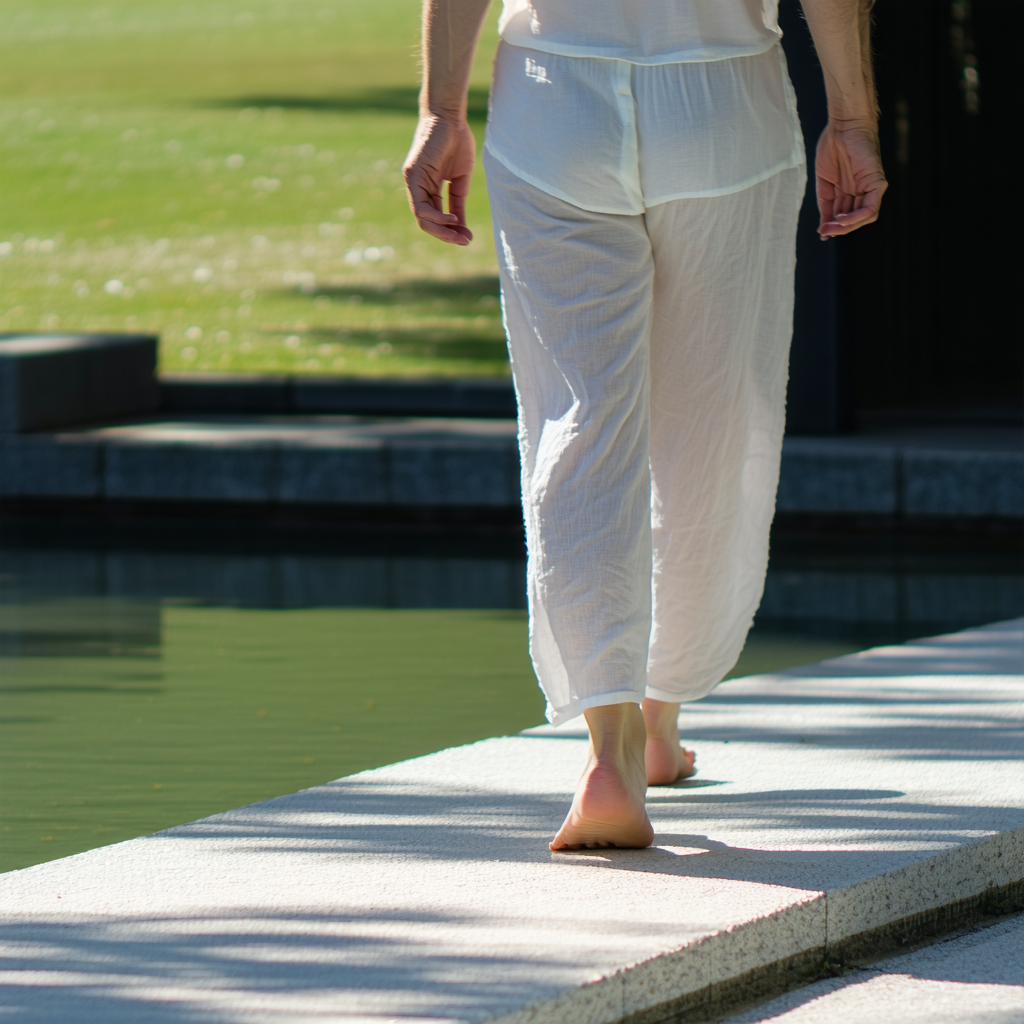
Walking meditation step by step – a complete practical guide
Walking meditation step by step is one of the most accessible mindfulness practices you can start today – no cushion, no studio, no prior experience required. In my own routine I have found that combining gentle movement with focused awareness often feels easier to sustain than sitting still, especially on restless days. This guide walks you through every stage, from choosing your path to deepening your practice over weeks and months.
Table of contents
- What is walking meditation
- Benefits supported by research
- Before you begin – what to prepare
- Walking meditation step by step – the full instructions
- Breathing and pacing
- Using anchor points to stay present
- Common mistakes and how to avoid them
- Variations of walking meditation
- Building a consistent habit
- Walking meditation vs sitting meditation
- Frequently asked questions
What is walking meditation
Walking meditation is a form of mindfulness practice in which movement itself becomes the object of attention. Rather than zoning out on a stroll, you deliberately notice each physical sensation – the lift of your heel, the shift of your weight, the feel of the ground underfoot.
The practice has roots in Buddhist traditions, particularly the Theravada technique called kinhin in Zen and cankama in Pali texts, but it has since been adopted widely in secular mindfulness-based stress reduction (MBSR) programs. It suits people who find seated meditation uncomfortable, fidgety, or simply boring.
What makes walking meditation distinct from a regular walk is intentionality. Every step is an invitation to return to the present moment rather than to plan dinner or replay yesterday’s conversation.
Benefits supported by research
Practicing walking meditation step by step on a regular basis may support both mental and physical wellbeing. Research published by institutions such as the National Institutes of Health suggests mindfulness-based practices, including movement meditation, are associated with reductions in self-reported stress and anxiety.
Some people find that a structured walking meditation step by step approach also helps with:
- Improved ability to concentrate throughout the day
- A greater sense of calm after sessions
- Reduced rumination – the tendency to replay worries on a loop
- Better body awareness, which may support posture and balance
- A gentle cardiovascular benefit layered on top of the mindfulness component
- An easier entry point into meditation for people who dislike sitting still
I want to be honest here: meditation is not a cure or treatment for any condition. But many practitioners, myself included, notice a measurable shift in mood and mental clarity after even a ten-minute mindful walk.
Before you begin – what to prepare
Choose your location
You do not need a forest or a retreat center. A quiet hallway, a backyard, a park path, or even a stretch of sidewalk works well. The key quality is predictability – a route where you do not have to make navigation decisions every few seconds.
For beginners, a straight path of about ten to twenty steps that you can walk back and forth is ideal. This keeps the practice contained and removes the mental load of deciding where to go next.
Decide on footwear – or go barefoot
Flat, flexible shoes let you feel the ground more clearly. Barefoot walking on grass or a clean floor amplifies sensory feedback and can deepen the practice. Avoid thick-soled running shoes for your first few sessions if possible – they can dull the foot-to-ground sensation that anchors the meditation.
Set a time limit before you start
Beginners often do best with ten to fifteen minutes. Knowing the session has a defined end point removes the restless wondering of “how long have I been doing this.” A simple phone timer set to a gentle sound works perfectly.
Wear comfortable clothing
Nothing constricting around the waist or legs. You want to feel your body moving freely, and tight clothing creates distracting physical noise.
Walking meditation step by step – the full instructions
Here is the complete walking meditation step by step sequence I use and teach. Move through each stage slowly, spending at least a minute with each before advancing.
Step 1 – arrive and stand still
Stand at the start of your chosen path. Place your feet hip-width apart, arms relaxed at your sides or clasped gently in front of you. Close your eyes for thirty seconds and simply feel the weight of your body pressing down through your feet into the ground.
Notice the subtle sway your body makes even when standing still. This is your baseline – the sensory starting point before movement begins.
Step 2 – set a clear intention
Open your eyes softly – gaze directed downward at about a forty-five-degree angle, not staring at the ground but not looking ahead at the horizon either. Silently state your intention. Something simple like “for the next fifteen minutes, I will pay attention to walking” is enough. Intention-setting primes your attention system and signals to the brain that this is not ordinary walking.
Step 3 – begin with a deliberate first step
Shift your weight onto your left foot. Notice the pressure change. Slowly lift your right foot – heel first, then the ball, then the toes. Feel the air under your foot for a moment. Place it forward, toes first, then ball, then heel. This is the walking meditation step by step at its most granular, and it may feel almost comically slow at first. That slowness is the point.
Step 4 – use a mental label (optional but powerful)
Many teachers recommend silently labeling each movement phase: lifting, moving, placing. Or simply left, right, left, right. The label is a verbal anchor that keeps discursive thought from taking over. When your mind wanders – and it will – the label gives you something concrete to return to.
In my own practice I spent the first two weeks feeling slightly ridiculous saying “lifting, moving, placing” under my breath. By week three it had become a natural rhythm that genuinely quieted mental chatter.
Step 5 – feel the full cycle of each step
As you continue, expand your awareness to the full cycle: the lifting, the swinging forward, the placing, the weight transfer, and the brief moment of double support when both feet are on the ground. Each cycle contains multiple distinct sensations. The more finely you can observe them, the less room there is for the mind to wander.
Step 6 – turn mindfully
When you reach the end of your path, pause. Feel both feet on the ground. Slowly turn – notice the shifting of balance, the rotation of your hips, the way your arms move slightly for counterbalance. The turn is often where attention collapses and the mind escapes. Treat it as its own mini-meditation within the session.
Step 7 – return and repeat
Walk back along the same path with the same quality of attention. Each pass is a fresh opportunity. Do not evaluate whether you are doing it correctly – simply keep returning to the sensation of each step whenever you notice you have drifted.
Step 8 – close the session intentionally
When your timer sounds, stand still again. Close your eyes. Feel your breath for three to five cycles. Notice any difference in your body compared to when you began. Open your eyes and take one conscious breath before returning to your day. This closing ritual helps consolidate the shift in awareness rather than letting it evaporate the moment you check your phone.
Breathing and pacing
Should you control your breath
In walking meditation step by step practice, the breath is often used as a secondary anchor rather than the primary one. You do not need to force a particular breathing pattern. Simply let the breath happen naturally and notice it as background awareness.
Some practitioners coordinate steps with breath – for example, two steps on the inhale, two steps on the exhale. This can be a useful training-wheel technique for keeping the mind engaged, but it is not required and can feel forced if the pace does not match naturally.
How slow should you walk
Much slower than you think. A useful rule of thumb: if a stranger watching you would not notice anything unusual, you are probably walking too fast for a formal walking meditation step by step session. Aim for a pace roughly one-quarter to one-third of your normal walking speed.
As your practice matures you can experiment with slightly faster paces, but the slow pace is where the real learning happens in the early weeks.
Using anchor points to stay present
An anchor point is any sensation you return to when the mind wanders. In a sitting meditation the breath is the classic anchor. In walking meditation you have several options:
- Foot sensations – the pressure, texture, and temperature of each footfall
- Leg sensations – the muscle engagement in calves, thighs, and hips
- Breath – used as a secondary anchor when foot awareness feels too subtle
- Sound – ambient sounds treated as neutral events rather than distractions
- Body as a whole – a wide-angle awareness of the entire moving body
Beginners typically do best with foot sensations as the primary anchor. It is concrete, always present, and rich in detail. Over time you can layer in the other anchor points to broaden awareness.
Common mistakes and how to avoid them
Turning it into exercise
The most common mistake is unconsciously shifting into exercise mode – picking up pace, swinging the arms vigorously, thinking about distance covered. Walking meditation step by step is not about cardiovascular output. If you notice your pace quickening, treat it as a mindfulness bell and return to deliberate slowness.
Expecting a blank mind
Meditation does not empty the mind. Thoughts will arise constantly – this is normal and not a sign of failure. The practice is the returning, not the absence of thoughts. Each time you notice you have drifted and come back to the step, that is a successful repetition of the skill.
Skipping the closing ritual
Many people stop the moment the timer goes off and immediately re-engage with their phone or to-do list. The closing ritual – standing still, feeling the breath, consciously transitioning – takes only thirty seconds and significantly improves how much of the calm feeling carries forward into the rest of the day.
Practicing only when stressed
Walking meditation is most effective when practiced consistently, not just as an emergency tool. Regularity builds the neural pathways that make the calm state more accessible even when you have not just meditated. Aim for daily practice even if sessions are short.
Choosing a distracting environment too soon
Parks with dogs, children, and cyclists are wonderful – but they demand significant attentional resources. Start in the quietest environment available and introduce more stimulating settings gradually as your concentration strengthens.
Variations of walking meditation
Traditional slow walking (Theravada style)
The most granular form, breaking each step into six phases: lifting, raising, pushing, dropping, touching, pressing. This is the approach used in intensive silent retreats and produces very refined body awareness. It is challenging for daily life use but worth exploring.
Zen kinhin
Practiced between periods of seated Zen meditation, kinhin involves walking at a slightly faster pace – roughly one breath per step – in a clockwise circle. The hands are held in a specific position (shashu) in front of the chest. This variation bridges sitting and movement practice elegantly.
Nature-based mindful walking
A less formal variation in which you walk at a normal pace outdoors but deliberately engage all five senses. What do you see, hear, smell, feel, and – if appropriate – taste. This approach is more accessible for people who find the ultra-slow formal style frustrating, and it still delivers meaningful mindfulness benefits.
Labyrinth walking
Many hospitals, retreat centers, and parks contain walking labyrinths – single-path circuits that lead to a center and back out. The defined path removes all navigation decisions, making it easier to drop into meditation. If you have access to one, it is worth trying.
Body-scan walking
A hybrid technique in which you systematically move awareness through different body parts while walking – feet, ankles, calves, knees, thighs, hips, abdomen, chest, arms, neck, face. This pairs well with slightly faster walking and is a useful variation when the standard foot-focused approach feels stale.
Building a consistent habit
Start smaller than feels necessary
Five minutes daily beats thirty minutes twice a week for building a durable habit. The goal in the first month is simply to make the behavior automatic – the length of sessions can grow naturally from there.
Attach it to an existing routine
Habit stacking – placing a new behavior immediately after an established one – dramatically improves follow-through. Walking meditation step by step pairs naturally with morning coffee, a lunch break, or the transition from work to home life.
Track without obsessing
A simple paper calendar where you mark each completed session provides just enough positive reinforcement without turning the practice into a performance metric. Some people find a dedicated app helpful; others find it adds friction. Experiment and use whatever actually works for you.
Join a group or class
Social accountability is one of the strongest habit-formation tools available. Many meditation centers, yoga studios, and MBSR programs include walking meditation components. Even an informal arrangement with a friend to practice and check in weekly can meaningfully improve consistency.
Be patient with plateaus
There will be weeks where the practice feels flat – no particular calm, no insight, just stepping back and forth on a path. This is normal and not a sign the practice has stopped working. Consistency through plateaus is what produces the long-term shifts practitioners report.
Walking meditation vs sitting meditation – a practical comparison
Neither form is superior. They develop slightly different qualities of attention and suit different temperaments and life circumstances. Here is a plain comparison to help you decide how to blend them:
- Physical comfort – Walking suits people with back pain, restless legs, or difficulty sitting. Sitting suits people with balance issues or limited mobility for walking.
- Depth of stillness – Many practitioners find seated meditation produces deeper states of internal quiet. Walking tends to produce a more alert, grounded quality of awareness.
- Ease of starting – Walking meditation step by step is generally easier for complete beginners because the movement gives the mind something concrete to follow.
- Location flexibility – Walking practice can be done almost anywhere without equipment. Seated practice requires a comfortable surface and some privacy.
- Integration with daily life – Walking meditation can be woven into commutes, lunch breaks, and errands. Seated practice typically requires a dedicated block of time.
- Recommended combination – Many teachers suggest alternating: a period of seated practice followed by a period of walking practice. The two forms complement and reinforce each other.
Frequently asked questions
How long should a walking meditation step by step session be for a complete beginner
Ten minutes is a realistic and effective starting point. This is long enough to move past the initial restlessness and settle into some degree of focused awareness, but short enough that it does not feel like a daunting commitment. After two to three weeks of daily ten-minute sessions, extending to fifteen or twenty minutes usually feels natural rather than forced.
Can I practice walking meditation step by step outdoors in a busy area
Yes, but I would recommend starting indoors or in a quiet outdoor space first. Busy environments – streets, shopping areas, crowded parks – introduce a constant stream of new stimuli that can make it very hard to sustain the focused attention the practice requires. Once you have built some concentration through quieter practice, introducing more stimulating environments becomes an interesting challenge rather than an overwhelming one.
Is walking meditation as effective as sitting meditation
Research on mindfulness broadly suggests that consistent practice of any recognized form – seated, walking, body scan – is associated with meaningful benefits. Walking meditation step by step may be particularly useful for people who struggle with seated practice, and some studies suggest it may have an edge in improving mood due to the combined effect of movement and mindfulness. The most effective form is the one you will actually practice regularly.
What do I do when my mind wanders during walking meditation
Notice that it has wandered – without criticism – and gently return attention to the sensation of your feet contacting the ground. That is the entire instruction. There is no need to analyze why the mind wandered, how long it was gone, or whether you are doing the practice correctly. The moment of noticing and returning is the core skill you are training, so in a very real sense, a wandering mind followed by a return is a successful repetition.
Can walking meditation help with anxiety
Many people find that regular mindfulness practice, including walking meditation step by step, may support a greater sense of calm and help interrupt anxious thought patterns. Some research suggests that combining physical movement with mindfulness attention may be particularly helpful for anxious states because it engages the body and gives the mind a concrete anchor. This is not medical advice – if anxiety is significantly affecting your life, working with a qualified mental health professional is the appropriate step.
Do I need to walk barefoot for walking meditation to work
No. Barefoot walking can enhance sensory feedback, which some practitioners find helpful, but it is entirely optional. The practice works perfectly well with shoes. If you do choose to walk barefoot, make sure the surface is safe, clean, and free of hazards.
How is walking meditation different from just going for a mindful walk
A mindful walk is a looser, more informal practice – paying gentle attention to the environment and your experience without a structured method. Walking meditation step by step is more formal: a defined path, deliberate pacing, a specific object of attention (usually foot sensations), mental labeling, and intentional opening and closing rituals. Both have value, but the formal structure of walking meditation tends to build concentration more systematically, especially in the early stages of practice.
Can children practice walking meditation
Yes, and many school-based mindfulness programs include simplified versions of walking meditation for children. The key adaptations are shorter sessions – two to five minutes – and more playful framing, such as walking like a slow-motion superhero or pretending the floor is made of something interesting. Children often take to the movement-based aspect more readily than seated practice.
For more practical wellness ideas, browse the Health Living Today guide library.